amazon banner

Wednesday, October 14, 2020

How to not crap out all your expensive nutrients

Let's start off with a basic argument: if you're crapping out all your nutrients, your muscles aren't getting bigger. Hence, you're not getting stronger.

That said, here are some basic guidelines to help you not watch all your expensive food flush right down the toilet bowl.

Since I have a sensitive digestive system and have problems processing lactose and casein, my number one is milk and all its derivatives.  

Milk products can come in many forms.  Butter, ice cream and so on and so forth.  It can also come in forms you might not expect like sour cream, certain types of cheeses, and as an added ingredient to foods like mashed potatoes, or buttermilk put in cole slaw, or Rice Krispy treats and certain types of chocolates.

To get around the lactose and casein, I drink pea protein while I workout.  The taste is like cow manure but it's cheap (around $15 for a tub of it on Amazon) and one scoop of it carries approximately 27 grams of protein.  One scoop mixed with water in a shaker bottle is all I can tolerate per workout.  Anymore than one scoop will cause me to get the sh*ts and make a run to the bathroom.


Second food I avoid is soybean oil and soy.  They also liquefy my guts into the toilet.  Unfortunately the only way to avoid it is I have to scrutinize every ingredients list on every food label before I consider buying it.  Soybean oil tends to creep in about 80% of the available food supply.   They put it in peanut butter, mayonnaise, certain types of Asian Sauces for stir-fry cooking, some brands of protein shake mixes, cans of tuna and other canned fish and meats, and even in ramen noodle instant and certain artificial butters.  The list goes forever and it's rare that a processed food from a can or plastic bag doesn't have soybean oil or soy but like I said I avoid it as best I can.

So it begs the question what the hell do I eat then?

I do mostly boiled chicken or rotisserie chicken I get from the grocery store.  I sometimes buy cuts of beef at the grocery store and I salt and pepper to taste or I put BBQ sauce on my protein. If I want carbohydrates, I'll boil up some noodles like pasta or maybe cook rice.  If I feel like I need some vitamins I'll eat fruits and vegetables canned or frozen or fresh.  For fats, I like to eat natural peanut butter.  It has the added benefit of increasing my level of satiety which gives me a nice full feeling after I eat lean pieces of chicken and get hungry again, so I reach for the natural peanut butter and put two cups of it on a plate and eat it raw.  It's called "natural" because there's no soybean oil in it. Natural peanut butter uses palm oil instead.

Another way to avoid emptying your guts into a toilet is to have good food hygiene.  What I mean is how you prepare your food and what cooking utensils you use to process your food.  To wash dishes, buy antibacterial grease lifting dish soap and then mix with a 1/2 cup of bleach into a tub or sink that doesn't leak.  Adding bleach can only be done with antibacterial dish soap because it doesn't have ammonia which when mixed with other soaps that do have ammonia can bond to the bleach to make something akin to the type of mustard gas used in chemical warfare during World War I.  Definitely something you don't want to breathe in while you're washing dishes.  

Probably the best investment you can make is to buy a high quality digital food thermometer,  It should go without saying that proteins have a risk of food borne viruses and bacteria, and the only way to kill them is to make sure your foods reach safe eating temperatures.  Chicken with bone in should be cooked to 180 degrees Fahrenheit.  Boneless chicken no more than 145 degrees Fahrenheit.  Beefs are tough to comment on because who wants to eat a leather shoe from beef that's been overcooked, but then again nobody wants beef that squirts blood into your eye when you poke it with a knife either.


Sunday, September 13, 2020

The Key to strength training: consistency

 No doubt this is a brutal workout that I espouse.  After a couple weeks, you'll feel sore or your joints will ache.  I even from time to time experience a weird phenomenon where I get anxious accompanied with muscle soreness and then my central nervous system gets hay wired from aching all the time and I start to feel unmotivated to workout for the simple fact that my body is sore.

At this point, I like to take what I call a break from my usual brutal workouts.  I workout just to maintain muscle memory.  Usually the workout takes 30 minutes to an hour.  I might pop off a couple singles.  I may do a couple doubles.  The key is to only spend about 10-15 minutes on each set and not try to set any personal records.  Just do enough to keep the joints and muscles in tune for your next taxing workout.

When do you do these muscle memory workouts?  Do them when you experience that weird aching listlessness accompanied with having a frazzled central nervous system.  That's my usual cue.  Maybe after you've had two or three weeks of taxing workouts, you go for a muscle memory workout and give your body and mind a break. The reason for the muscle memory workout is just to maintain consistency.

I don't advocate more than 96 hours of rest or even the occasional rarity of 120 hours rest between workouts.  72 hours of break time between workouts is ideal but that can lead to mind and body fatigue after a couple weeks.  If you go to an extreme of strength training only once a week, you'll probably start losing strength after the second week so skipping workouts in the name of rest and repair is a setup to fail in your strengthening endeavors.  Just do the muscle memory workouts and you'll maintain strength so on the next workout you can start making personal gains again.

Tuesday, September 8, 2020

Fok the Gym: the fundamental theorem of arm pressing

If calculus can have a fundamental theorem then why can't I?  Thus, the fundamental theorem of arm pressing.

Let's clarify a few terms before I go on.  

First what do I mean by arm pressing? It could be a shoulder press, a bench press, a dip, a decline press, so on and so forth.

Second what do I mean by fundamental theorem?  Fundamental to any arm press, there are three fundamental movements.  The first is the sweeping backwards of the shoulders.  Second is the acute angle between forearm and bicep that is formed when one lowers the bar to his chest or anytime the the knuckles of the hand are in parallel or below the chest.  Third is the wrist joint.  Often overlooked in arm press training, the wrists are one small important part of the kinetic chain in the arm press movements.

Now I'm going to blow your mind.

I claim that without a strong bench press you can't have a strong shoulder press, or without a strong decline press you can't have a strong behind the neck press.  In other words, all arm pressing is interrelated and dependent on each other because of the simple fact of the fundamental theorem of arm pressing.

All the varieties of arm pressing all follow the same principle:  sweep the shoulders rearwards, form a twenty degree or less angle between forearm and bicep making them almost touch each other, and use the wrists and hands as bar stabilizers during the movement.

Now what do you do with information?

The answer is train all varieties of arm pressing even if your only goal is to get stronger in the bench press, or shoulder press, etc., because they are all linked in a symbiotic kinetic chain.


When training the bench press, your pectoral muscles and front deltoids will fatigue quickly.  Remedy that by moving onto the shoulder press.  It will still train your upper pectorals and upper deltoids, and that will have tremendous strength training carry over to your bench press but lessen the stress on the lower pectorals and front deltoids. Then move onto a behind the neck shoulder press because that will focus on the posterior deltoids and triceps and wrists and forearms.  

A side note about the dip. Dips only lead to strength carryover to other arm presses if they don't violate the fundamental theorem of arm pressing which means the shoulders sweep backwards putting a nice stretch on the pectorals and front deltoids, the wrists and forearms stabilize the movement and the acute angle between bicep and forearm closes them together almost touching each other.

Another side note.  Cable tricep pushdowns have zero strength carryover to any arm press.  For the fact the cable pushdowns violate the fundamental theorem of arm pressing.  True, the movement forces the angle between forearm and bicep closed but it completely misses the pectoral and front deltoid stretch.  That stretch is essential for any accessory movement to have strength gain carryover to any arm press.

Last but not least are the wrists and forearms.  Train the wrists by putting them close to each other in the middle of the bar while arm pressing.  This will also tax your forearms.  Then to hit the forearms, alternate on one day with underhand bicep curls and then on your next workout, do overhand bicep curls.  Overhand bicep curls will alleviate stress on your bicep tendons and will minimize the chance of bicep tendon tears.

Sunday, August 30, 2020

Intra-workout protein intake

You need to consume protein while working out to maintain and gain strength while training.  The question is what is too much and what is too little?

The answer is it's a yin yang dilemma.

On the one hand, if you drink too much protein shake while working out you'll be crapping out your expensive protein down the toilet.

Alternatively, if you drink too little you'll be missing out on strength gains.

If you look at the body as a closed loop system, you input a variable into your digestive system and what comes out is a function of that variable.  The variable is protein intake.  The body's strength performance is the function.

And your body will give you cues as to how much protein to take in.  

The first cue for too much protein is upset stomach or a gurgling in the large intestines. Take in more protein, you will urinate or maybe fart(protein farts).  Still take in more and more protein, you will most likely have to empty your bowels and expensive protein down the toilet.  Not only does this cost a lot of money (protein shake is not cheap), but also it will add more time to your workout and break the rhythm of your routine. So the lesson here is at the first tingling of upset stomach, no matter how small, cut out the protein intake.  Wait until after you complete a couple more sets and then maybe take a small bit of protein in.  If you're going to err, it's best practice to take in only enough to barely get you through the workout.

Now here's how to tell if your intra-workout protein is too little.  My first and most important cue to insufficent protein intake:  I usually get a trembling weakness in my quadriceps when I stand or in my glutes and hamstrings when I bend over.  If you keep going with deficient protein, you will be missing lifts you could otherwise make had you digested enough protein.  At its most extreme, you'll be risking rhabdomyolysis -- a condition in which your body breaks down skeletal muscle that could lead to kidney damage. So when I get this trembling weakness, I drink protein shake but not too much. 

It's definitely an art form to tell when you had too much or too little protein.  Hopefully you master it quickly enough to give you those most sought after gains.

Wednesday, June 6, 2018

Thoughts on bench press: glute drive or leg drive?

Mark Bell talks about glute drive in one of his videos on YouTube.

Basically before you push the bar off your chest in the bench press, you pretend like you're trying to crush a walnut stuck between your butt cheeks.  When you do this, the bar seems to according to Mark Bell "magically levitate off your chest".

The legs and feet are just there to stabilize you while you press, and there is a significant amount of arch applied to the lower back when applying a rock hard contraction to your butt so be mindful of that and keep your lower back as flat as possible. Otherwise you do risk suffering a sore lower lumbar region after you workout.

Saturday, June 2, 2018

Thoughts on bench press: how to look like a moron

You wanna look like a moron at the gym? Do these bench press accessory movements:


The first one is my invention and I'm copywriting it here.  Anybody laying claim to it is stealing from me and will be appropriately dealt with.

I don't know what to call it. It's some weird hybrid suicide bench press mixed with a decline press and to really screw with your front deltoids I added a drag to it where you let the bar slide down your chest until it barely reaches your wind pipe just below the Adam's apple and then you push drag it on your chest and back up to your belly button whereby you decline press it back up to a locked elbow position.

Use a sit up bench set at the steepest angle setting and make sure the squat rack safety bars are positioned just above your throat unless you feel like crushing your wind pipe in case you miss the lift.  Sometimes I miss and have to turn my head to the side to get my head out from under the bar.

This kind of movement will severely stress your front deltoids and will flare up any shoulder injuries, but hey it works getting you out of any bench press plateaus.

The second movement is the close grip bench press everybody tells you not to do, so if some sh"t-for-brain know-it-all tells you you're doing it wrong tell him to go f"ck himself and mind his own motherf"ckin business.  

Once again position the safety bars barely above the arc of your gut just in case you miss.

You do both of these accessory movements on one day and then after rest and eating protein, for your next workout you do bench press and shoulder workout to keep your shoulders healthy and strong.

Tuesday, March 20, 2018

Thoughts on the bench press: triceps

Do this as an experiment:

Get on the floor and bang out some push-ups.  Now take your hands and position them close together so that your palms and fingers and thumbs form a triangle of empty space.


Now do pushups with your hands in the position above.

The point I'm trying to prove is you should be weaker with your hands in the triangle position than with your hands spread out in a regular normal pushup.

Now apply this principle to your bench pres training. Get underneath a bar in a bench press position and take both of your hands and move them close together in the middle of the bar.  Now bench press. 

You should be significantly weaker in this hand position than in the position with hands spread wide on the bar.  If you believe in the mantra "you're only as strong as your weakest link", you will notice if you have weak triceps you can't bench press much weight. This kind of close grip bench pressing will hit your weak triceps and stimulate them to their full potential.

Bench pressing in this close grip position will also adress weakness in the wrists as well.  Because the wrists take on an unnatural bent inwards and backwards position, they get taxed as well due to the awkwardness of the hand placement on the bar in this style of close grip bench press.

Since this style of close grip emphasizes the triceps, you will have to incorporate a front deltoid exercise such as the decline bench press. The decline press taxes the front deltoids for the simple fact no leg drive is activated in this movement because your feet are bound underneath the foot holder on the sit up bench. Additionally, it's best to angle the sit up bench to its highest position to deemphasize leg drive and provide the opportunity for the front deltoids to take on the brunt of the work in the decline press.

If you're going to do accessory work, the triceps and front deltoids and pectorals should all be worked at the same time.  This is why so much frustration is experienced when expecting gains in the bench press when all you're doing for accesory work is cable tricep pushdowns.  This type of movement is useless to bench press gains because it misses the front delts and pectorals.  The successful strength trainer and strength gainer will know that the only accessory conducive to bench pressing strongly is one that involves triceps, pectorals and front deltoids simultaneously.

Monday, March 19, 2018

Thoughts on the bench press: wrists

Sure, you can look at any explanation of bench press form on YouTube and think you got it all figured out.  But the one thing they always miss is the wrists.

If you look at the bench press as a kinetic chain, you will notice the movement involves the triceps, front deltoids, pectorals and legs.  But the weakest link in that chain are your wrists.

If you bench press without wrist wraps, you are setting your wrists up to fail and consequently you miss the lift.  When you unrack the bar and bring it over your face and then lower it down to your chest, your wrists take on a folded over backwards position with your knuckles pointing to your face.  If you begin your press in this wrist position you are going to miss your lift.

To remedy this malady of weakness and to fully engage your triceps and pectorals and front deltoids, you have to literally flip your wrists to a perpendicular position relative to the bar when the bar is laying on your chest. There should be a ninety degree angle formed by your wrists connected to the bar via your hands to assume the right angle position in order for you to explode your arms away from your chest. That flip will greatly enhance your bench pressing ability.


To train this flip I decline bench press, and
when the bar reaches midpoint between chest and stomach I let the bar slide down towards my neck right below my Adam's apple and try to slide the bar on my chest back towards my stomach and then push my arms away from my body.  Of course you need to do this in a squat rack with safety bars situated above your windpipe to prevent the bar from choking you if you miss. This movement emphasizes the front deltoids and wrists.

I am a bitch

 2018/03/18 12:17

Gym
10 up 15 bottom Bench press    195-.2, 205-.1, 215-0


5 up 8 bottom Standing shoulder press 155-.2

5 up 8 bottom Standing behind the neck shoulder press 125-.2, 135- .1

One legged leg press
Left 100-.1, 100-.2
Right 100-.1, 100-.2


1in. Deficit deadlift 385-.1, 405-.1

Dumbbell finger grip 110-0


 2018/03/10 12:31

Close grip bench press 10 up 14bottom
135-1, 155-.1

11 up 16 bottom Decline bench press  195-0


Conventional deadlift   395-.2, 405-.1, 405-0


5 up 14 bottom Pause squat  285-. 2, 300-.1, 275-1


Stiff legged deadlift  385-0

One hand finger grip bicep curl
Left 75-0
Right  75-.1


 2018/03/05 14:26

Gym
10 up 15 bottom Bench press    195-.1, 205-0 205-0


5 up 8 bottom Standing shoulder press 145-.2, 125-1

5 up 8 bottom Standing behind the neck shoulder press 115-.3

One legged leg press
Left 85-.2, 100-.1
Right 85-.2, 100-.1

 2018/02/28 10:53

11 up 16 bottom Decline bench press  185-1, 195-0

Close grip bench press 10 up 14bottom 135-0, 115-2, 125-1, 135-.1


Conventional deadlift   395-.1


5 up 14 bottom Pause squat 285-.1,  285-. 2


Stiff legged deadlift 365-.1, 365-.2

One hand finger grip bicep curl
Left 75-0
Right  75-.1


1in. Deficit deadlift 365-.2, 365-.3

Dumbbell finger grip 100-.5, 110-.1, 120-0


 2018/02/24 12:58


Gym
10 up 15 bottom Bench press   180-.1, 180-.2, 180-1


5 up 8 bottom Standing shoulder press 145-.2

5 up 8 bottom Standing behind the neck shoulder press 115-.1

One legged leg press
Left 85-.1
Right 85-.1


1in. Deficit deadlift 345-1, 365-.1

Dumbbell finger grip 100-.1


 2018/02/16 14:07

11 up 16 bottom Decline bench press  185-.1, 175-1,


Conventional deadlift   395-.2, 395-.1


5 up 13 bottom Pause squat 265-1, 285-.1


Stiff legged deadlift 365-.1

One hand finger grip bicep curl
Left 70-.1,  75-0
Right  70-.1, 70-0

 2018/02/12 12:58


Gym
10 up 15 bottom Bench press  195-0,  185-.1, 180-1, 190-.1, 205-0


5 up 8 bottom Standing shoulder press 145-.2

5 up 8 bottom Standing behind the neck shoulder press 115-.3, 125-.1

One legged leg press
Left 85-.2
Right 85-.2


Deficit deadlift 355-1, 375-.1, 375-.2

Dumbbell finger grip 90-.3, 95-.2, 100-.1

 2018/02/08 16:50

11 up 16 bottom Decline bench press 195-.1, 185-.1


Conventional deadlift  365-1, 395-.1, 395-.2


5 up 13 bottom Pause squat 265-.1,


Stiff legged deadlift 345-1

One hand finger grip bicep curl
Left 65-.2, 70-.1
Right  65-0, 70-.1

  2018/02/04 14:11


Gym
10 up 15 bottom Bench press  175-1, 195-0


5 up 8 bottom Standing shoulder press 120-1, 135-.2

5 up 8 bottom Standing behind the neck shoulder press 105-1, 115-.1, 115-.1

One legged leg press
Left 85-.2
Right 85-.2


Deficit deadlift 325-1, 350-.2, 350-.2

Dumbbell finger grip 90-.3

 2018/01/31 08:32

11 up 16 bottom Decline bench press 195-.1
Conventional deadlift  345-1, 355-.1, 365-.1
5 up 13 bottom Pause squat 250-1, 260-0
Stiff legged deadlift 325-1, 345-.1
Pull up two handed
One hand finger grip bicep curl
Left 60-.2, 65-.1
Right 60-.2, 65-.1


 2018/01/27 08:36


Gym
10 up 15 bottom Bench press  185-.1,


5 up 8 bottom Standing shoulder press 120-1, 135-.1

5 up 8 bottom Standing behind the neck shoulder press 105-.4

One legged leg press
Left 85-.1
Right 85-.1


Deficit deadlift 325-1, 375-.2

Dumbbell finger grip 80-.9, 90-.2


Here's my weak bitch records.

Did know this strength training crap causes impotence?

That's why I go here.


I take about four of these at a time, and turn myself into a sex machine.

I suffered a shoulder injury and that prevented gains in the bench press.  My injury was caused by doing dips in fifteen degree freezing weather. Apparently your shoulders have to be really warmed up and loose before undertaking dips.  Otherwise  you risk ripping your rotator cuffs in your shoulder joints.

I've been trying to make a fool out of myself by eating whole chicken roasters and drinking diet coke at the gym as intra-workout nutrition to help me with my most sought after gains, but I always get a kick out of having a chicken drumstick in my mouth while the person next to me is changing into their gym shoes.

Bench press nags me with weakness and pain thanks to the previous mentioned shoulder injury. To rehab the shoulder I do the above movent with a ten pound weight instead of a stick.


Thursday, November 16, 2017

Keto Diet is bullsh*t

The keto diet's basic tenet is if you keep insulin levels low in your bloodstream, then you will stave off hunger and lose weight as a consequence.

As it applies to strength training, the keto diet is almost mandatory if you plan on lifting more weight. My argument is that for the simple fact the stomach can only handle a fixed volume of food and since protein consumption is absolutely necessary for muscle building, one must adapt one's diet to a ketogenic diet.

Typically keto diets are high fat, moderate protein and low carb. The strength trainer's diet is high protein, moderate fat, low carb.  High protein for muscle building.  Moderate fat to keep blood insulin levels stabilized which facilitates muscle protein synthesis.  Low carb again to keep blood insulin levels low.


This represents the perfect ketogenic meal for while working out and up until 48 hours after the workout.  It's chicken and guacamole.  The guacamole has tomatoes, onion and avocado so it's not perfectly ketogenic but it's pretty close because it has only 50 grams of carbs.  If you still feel lightheaded after eating this, eat a couple slices of bread to feed your brain glucose.

I'm beginning to think that during your workout, what matters most is how low you can keep your blood insulin levels.  I used to think that an abundant protein intake was necessary for making personal records in your lifts but now I'm beginning to see that when you keep blood levels low, not only is the need for protein less but also I feel much stronger because my blood insulin levels are kept from spiking too high thanks to the use of avocado during the workout.

Sunday, October 29, 2017

48 hours after workout: protein intake

Without question, the first 48 hours after you workout heavy you will need to stuff your gut with fatty beef if you hope to gain muscle and get stronger.

After those 48 hours what happens then?

I workout every 72 hours approximately. That means I got 48 hours of copious beef consumption but what happens after that? I still got 24 hours left until my next workout.

The answer is eggs. I'll go to Dunkin Donuts and get egg and bacon on plain bagel.  That'll be my main staple protein source for those 24 hours leading up to my next workout.

My reasoning is that per egg there are only 4 grams of protein but as far as amino acid profiles go, there is no food more perfect than an egg. They have all the amino acids in small proportions but they will satiate your muscles' constant hunger for protein without overdosing.  Too much protein will cause your body to expel it, and when that happens you're watching all of your expensive protein being flushed down the toilet.

Of course as you get stronger, that 48 hours time limit for protein intake will become irrelevant as you will be in constant need of protein to get stronger.  Then you'll run into the problem of not getting enough protein ever.

Saturday, October 28, 2017

The aha moment: McDonald's double quarter pounder no cheese no salt no bun

The mere fact that I can put a McDonald's double quarter pounder in a car, leave it over night and then come back in the morning and eat it for breakfast without getting food poisoning should at least make you ponder for a brief moment as to what they're putting in that burger meat.

But hey I'm all about candid honesty so I have to be truthful no matter how unpalatable the facts are:   McDonald's double quarter pounders no cheese no bun no salt made me stronger.


Look at my numbers.

 2017/10/27 12:03

Gym

 Decline bench press 205-.5, 215-0, 225-0
Conventional deadlift  365-1, 415-.1
Pause squat 235-.1, 225-.8, 275-.1
 Rack pull 505-.1, 455-1, 525-0


Gym 2017/10/21 08:56

 Decline bench press 205-.1, 205-.2, 215-.1, 225-0
Conventional deadlift  365-.4, 415-0, 365-.7, 415-.1
Pause squat 235-.3, 245-.2, 225-.9
Rack pull 505-0, 455-.2

Conclusion:

The training was the same, the rest intervals were the same.  The only difference between the first and second workout is that I used McDonald's double quarter pounders no cheese no salt no bun as a post-workout protein source for the first 48 hours after my workout for the time proceeding my 10/27 workout.  For the
10/21 workout I used steak from a Mexican restaurant as a post workout protein source.


As far as I know cows have no significant differences between them as far as protein content goes, so maybe it's the preservatives McDonald's puts in their burgers that gave me the strength gain.  Who knows?

Tuesday, October 17, 2017

Meager Beginnings

Gym 2017/10/15 09:52

Decline bench press 205-.1, 225-0, 245-0
Conventional deadlift  425-0, 365-.2, 415-.1
 Pause squat 235-.9, 255-.1
Rack pull 505-0, 455-.7


Gym 2017/10/12 09:42
 Bench press  210-.1, 225-0, 275-0, 260-0
Standing shoulder press
 195-.1, 205-0, 145-.2
Standing behind the neck shoulder press 195-.1, 205-0
Bent over barbell row 335-0, 285-.2, 305-.1
One legged leg press
Right 85-.1
Left 85-.1
Stiff legged deadlift 365-.2, 425- 0


Gym  2017/10/09 07:48
 Decline bench press 225-0, 245-0, 205-.7
Conventional deadlift  425-0, 365-.8
Pause squat 235-.6
Rack pull 505-0, 455-.3


Gym  2017/10/06 07:31
Bench press 205-.2, 235-0, 255-0
 Standing shoulder press 175- , 135-.1, 185-0
Standing behind the neck shoulder press 185-0
Lat pull front 110-.3
Lat pull back  200-
Lat row 250-.1, 250-.2
One legged leg press
Right 65-1
Left 65-1
Stiff legged deadlift 425-0


Gym  2017/10/03 07:55
Decline bench press 225-0
Conventional deadlift 365-1, 425-0, 415-.1
Pause squat 235-0, 225.3, 215-.9
 Rack pull 495-.1 , 465-.3


Gym 2017/09/30 09:21
Bench press 220-0, 235-0
Standing shoulder press 155-.1, 175-0
Standing behind the neck shoulder press 115-.1, 125-.1
Lat pull front 110-.1
Lat pull back 120-5, 160-1.2, 200-.1
Lat row 250-.2
One legged leg press
Right 65-.1
Left 65-.2
Stiff legged deadlift 425-.1


Gym  2017/09/27 11:10
Decline bench press 195-1, 205-.1, 215-0
Conventional deadlift 375-.1, 425-0, 375-.1
Pause squat 185-1, 235-.1, 205-1, 225-.2, 215-1, 225-.1
Rack pull 495-0, 465-.3, 485-0


Gym  2017/09/24 08:35 
 Bench press 185- 1, 235-0, 205-.1, 195-.2, 
Standing shoulder press 135-.2, 115-.2, 155-.1
Standing behind the neck shoulder press 115-.1 , 125-.1
Lat pull front 110-.1
Lat pull back 110-.2, 120-.1
Lat row 230-.2, 250-.1
Stiff legged deadlift 375-.2, 425-0, 375-.2
One legged leg press
Left 65-0, 65-.2
Right 65-.2, 65-.2

Gym  2017/09/21 09:28 
Dip assist machine 60-.1, 60-.1, 45-.1
Conventional deadlift  325-.2, 375-0, 390-.1, 425-0, 325-1, 375-0
Rack pull 495-0, 455-.1, 455-.1, 
Leg press machine 370-.1, 370-0


Gym  2017/09/18 11:43 
Bench press 195-.2, 235-0
Standing shoulder press 135-.1
Behind the neck shoulder press 115-.1
Stiff legged deadlift 325-.7, 375-.1, 375-.1
Lat pull down behind the neck 100-.3, 110-.1
Lat pull down front 110-0
Lat row 230-.1
One legged leg press 
Left 40-1.3, 60-0, 65-0
Right 40-1.1, 60-.2, 65-0


Gym  2017/09/15 06:31 
Conventional Deadlift 325-.2, 375-.1, 325-.3, 325-.7, 395-0
Dip assist machine 85-.9, 55-0, 70-.1
Rack pull 415-.6, 465-0, 435-.1, 435-.1, 
Leg press machine 325-.2, 370-.1


Gym  2017/09/12 10:16 
Bench press 235-0, 185-1
Standing shoulder press 135-.1
Stiff legged deadlift 325-.1
Lat pulldown 100-.1
Lat row 220-.2


Gym
 2017/09/09 10:23 
Conventional deadlift 335-.3, 335-.2, 385-.1
Bench press 185-.8, 205-0
Assist dip 85-.1
Leg press 325-.1
Rack pull 405-.2, 455-0, 430-0

 2017/08/31 14:49 
Bench 235-0
Dead 365-.1
Lat pull down 80-1
One legged leg press 
Right 40-.3
Left 40 -.3


I use a rating system to document my lifts.   One full with good enough form repetition counts as “1”. Two quality reps with decent form count as “2”.  

Any number  with a decimal point in front of it represents a partial rep or a miss.
A “.9” represents a rep with not very good form but I still completed it.  A  “.4” means I got the weight almost half way up.  A “.3” represents the  bar traveled far less than half way.  And “.1” means I barely cleared the  weight from whatever it was resting on or I barely came out of the hole with it or I slightly budged it off my chest. A “0” means no movement of the weight just force being applied to it but it stays stationary -- essentially turning it into an isometric movement. Any number I failed to mention, just remember a “1” is a complete rep and a “0” is isometric.

Work out notes:

Not much to say really.  I'm back in the gym.  

Bench press remarks:

I'm beginning to think of the bench press as a movement that is just not isolated to the front deltoids, triceps and pectorals.

Rather it is a symbiotic cooperation between triceps, pectorals, and all of the heads of the shoulder deltoid muscles which include the front, lateral, and rear deltoid. 

Hence my workouts reflect that thought.  I do shoulder presses, behind the neck shoulder presses, and bench press on one day.  Then the next workout I do decline bench press.

The rationale behind this is the bench press has too many micro oscillations in the bar path to constrain it to the just the front deltoid.  True, off the chest the bar path comes straight up the first two or three inches but then it gently arcs upward toward directly perpendicular to over your head closely mimicking the shoulder press movement.

Further what if you're maxing out and the bar path becomes erratic while you're struggling to push the weight up.  Your elbows and shoulders don't maintain perfect form.  They take on positions that kind of approximate the behind the neck shoulder press.  The elbows tend to flare out.  The elbow joints take on sharper angles, and tricep muscle recruitment dominates over front deltoid and pectoral involvement -- just as it does when one behind the neck shoulder presses.

The behind the neck shoulder press is accomplished by putting the bar on the back of your neck as if you were squatting. Then with both hands press the bar off the back of the neck in a vertical movement towards the ceiling. It emphasizes tricep, forearm and wrist strength which are all important to the bench press. 

Another reason is the law of radiation.  This simply means flexing one muscle tends to contract the surrounding muscles. Wouldn't it stand to reason that if you had strong thick lateral and rear deltoids, then your front deltoids would contract stronger and more forcefully and enable you to support heavier bench press loads?  That's why I do the shoulder press and behind the neck press and decline press in addition to the bench press to increase my bench pressing weight.

Intra-workout protein intake:

I've totally ditched the powdered crap in the tub protein shake, and I'm using fatty steak as an intra-workout protein supplement.  

The reasoning is two-fold.  First, the powdered sh$t in a tub protein shake does exactly that:  it makes me crap my guts out while I train.  It probably has something to do with the nasty emulsifiers, and artificial preservatives and sweeteners and God knows what else the unscrupulous sh$thead protein manufacturers are putting in their sh$tty protein powder. All I know is that dried protein powder in a tub makes my anus vomit.  

Rarely do I have problems with eating steak while I workout.  No more liquefied protein sh$ts in the middle of my training sessions which shortens the duration of my workout.  Good riddance to the nasty dried powder crap in a tub.

The second reason I've converted to steak is that steak is less insulinogenic especially when it's greasy and fatty.  This helps thwart your body releasing insulin hormone into the bloodstream which will in turn help assimilate dietary protein into the muscles.  

This video can explain this concept better than I can:


Friday, August 25, 2017

No pain, no gain?

I recently started using this post workout to combat soreness, achiness, and inflammation.

It works pretty well.  It's almost like I didn't workout.  Probably around ninety percent of my joint stiffness and muscle aches have subsided.

It's not one hundred percent effective but still it's better than nothing.

I took two tablets approximately six hours after  my workout.  I then went to sleep and woke up the next day relatively pain free.

As with any drug, there probably is a point of diminishing returns and my body will develop a tolerance to bromelain but I don't know when that will be, so I'll remain in blissful relatively pain free ignorance.

Only bad thing about it is since I use my level of post workout soreness as a gauge to tell me when to workout again, the bromelaine reduces that achiness and inflammation and consequently I won't be able to tell  when I can go stress my muscles again.  Oh well.  Always a catch.

Fok the gym


Pre-Workout Meal:


I eat the steak and over-easy eggs along with the rice and beans pre-workout, and I wash it down with Diet Coke.


Intra-workout:

I only eat the steak and eggs while I'm working out.  Meats and eggs have a very low insulinogenic effect which is good because you don't want to sugar crash while you workout because it will weaken your lifts and hence you won't get strong.

As you can see, I only have a limited amount of steak so I try and pace my eating, so I can have some for all three phases of workout supplementation:  pre-, intra-, and post-workout.

Workout Equipment:

This is my deadlift station.  The big rebar loop hanging out of the concrete block is good for single- and double-handed isometric rack pulls. Unfortunately there's no way to gauge if I'm getting stronger with isometric movements, but I can swear I feel that rebar giving way like I'm bending it upwards.

The smaller rebar loop on the bottom makes for a nice Ass-to-Grass single- or double-handed isometric deadlift.  I try to get my center of gravity over that loop, sink either one or both shoulders way back like I'm stuffing my hand or hands in my backpockets, and activate my glutes and calves and try to bend that rebar upwards.


Dip station:


Put either hand on one side and the other goes on the other side.  Dip in between the concrete blocks.


Lat Station:


Wrap one or both hands around that angled pole and then plant both feet on the edge of that sheet metal base, use your torso and legs as dead weight to provide some resistance, and shred your lats and biceps until they burn like battery acid.


Pullup station:


Wrap both hands on top of that horizontal piece of steel and you got your pull up bar.


Some notable mentions:


I use that curb in the first picture for uneven pushups.  They serve as a progression to eventual one hand pushups.  

The other pictures just show some gripping points that I could contract large muscle groups with isometric deadlift pulls.  


Pistol Squat station:


Steady yourself by latching the hand closest to your leg you're trying to pistol squat with.  Then slide the hand down the pole as you lower your body to the ground.

Hand protection:


I don't want to mangle my hands so I wear these gloves.

Thursday, August 10, 2017

F*ck the protein shake

All protein powders are crap.  They make me crap.  Who knows what all they put in that crap.

There’s no FDA regulation of any supplement company here in America, so the protein powder making companies can put any goddamn thing they damn well please.  They lace their supplements with oral steroids.  They cut the protein with cheaper protein powders to make you think you’re getting a better protein bang for your buck.  All in all, I hate those bastards with a passion.

What’s the solution you ask?

Just handle it like you would any other good for nothing bitch you have the unfortunate chance of meeting in your life:  kick that piece of garbage to the curb and replace it with something better.

What’s better than the supposed almighty protein shake that all those shills on youtube constantly bombard you with on a daily basis you ask?

How about the real thing smartguy is my answer to you.

What’s real protein you ask?

Real protein is beef, chicken, fish.  

You see, I haven’t been going to the gym like I like to so I do ghetto workouts in the middle of a parking lot that has a chainlink fence, cars, a couple poles with street signs attached to them.  I mostly concentrate on bodyweight exercises except when I’m trying to deadlift a car.  I got these heavy duty gloves from Walmart and I wrap them around the fence poles and concrete rebar in this parking lot, and I yank on them and do pushups and dips on them to get my workout.

Another thing I do while I’m working out is eat my pre-workout meal of steak and eggs, rice and beans.  Then while I’m working out I continue eating my steak and eggs but forgo the rice and beans.  You only need the steak and eggs to provide the body glucose without a severe insulinogenic response.  

Notice one thing.  I’m not drinking protein shake crap.  I’m eating dead cow flesh while I’m working out.  And honestly I can’t tell the difference between protein shake and steak as an intra-workout supplement.  I shove the steak in my mouth after busting out pushups and my body has no problem using that steak to repair muscles and tendons and ligaments and provide a source of glucose for energy reserve replenishment.  

So yeah, “f” the protein shakes.  “F” the protein powder making companies.  “F” those lying bastards on youtube prostituting themselves out like whores to the protein powder making companies.

Is steak more expensive than that sewer water protein shake you ask?

You bet your sweet bippy it is.  But I’ll take savory good tasting cow carcass over that crap that they shove in those tubs and market that nasty sh*t as something healthy that’s going to give you those most sought after gains.

You could always try tuna from a can or a bag of chicken for your intra-workout protein source.  They might possibly be cheaper.  

Monday, January 23, 2017

Bench press alternate accessory movement

There is no question you need to mix up your movements to avoid repetitive movement injury.  The problem is finding the right accessory movements that will have carryover to your bench press that will lead to making strength gains in your chest press.

I was experimenting with dips in my last workout sessions, and I was noticing definite progress and increase in my bench press strength.

The way I would do dips is I would get on the dip machine at the gym and go all the way down with elbows bent at a severely sharp angle with my forearms hinging at the elbow and not stopping until I hit the the bicep with my forearms and then I would push myself up.


The use of the above machine allows you to acquire that severe acute angle in your elbow joint which is necessary to mock the angle joint your elbows take on while bench pressing.  That's the movement that needs to be accomplished if you expect strength gain carryover to the bench press.

If you want to add more resistance to the exercise once you master a severe bent angle elbow position dips with both hands, switch to a one handed dip.  You can accomplish this because the knee pad on the machine will support your weight.

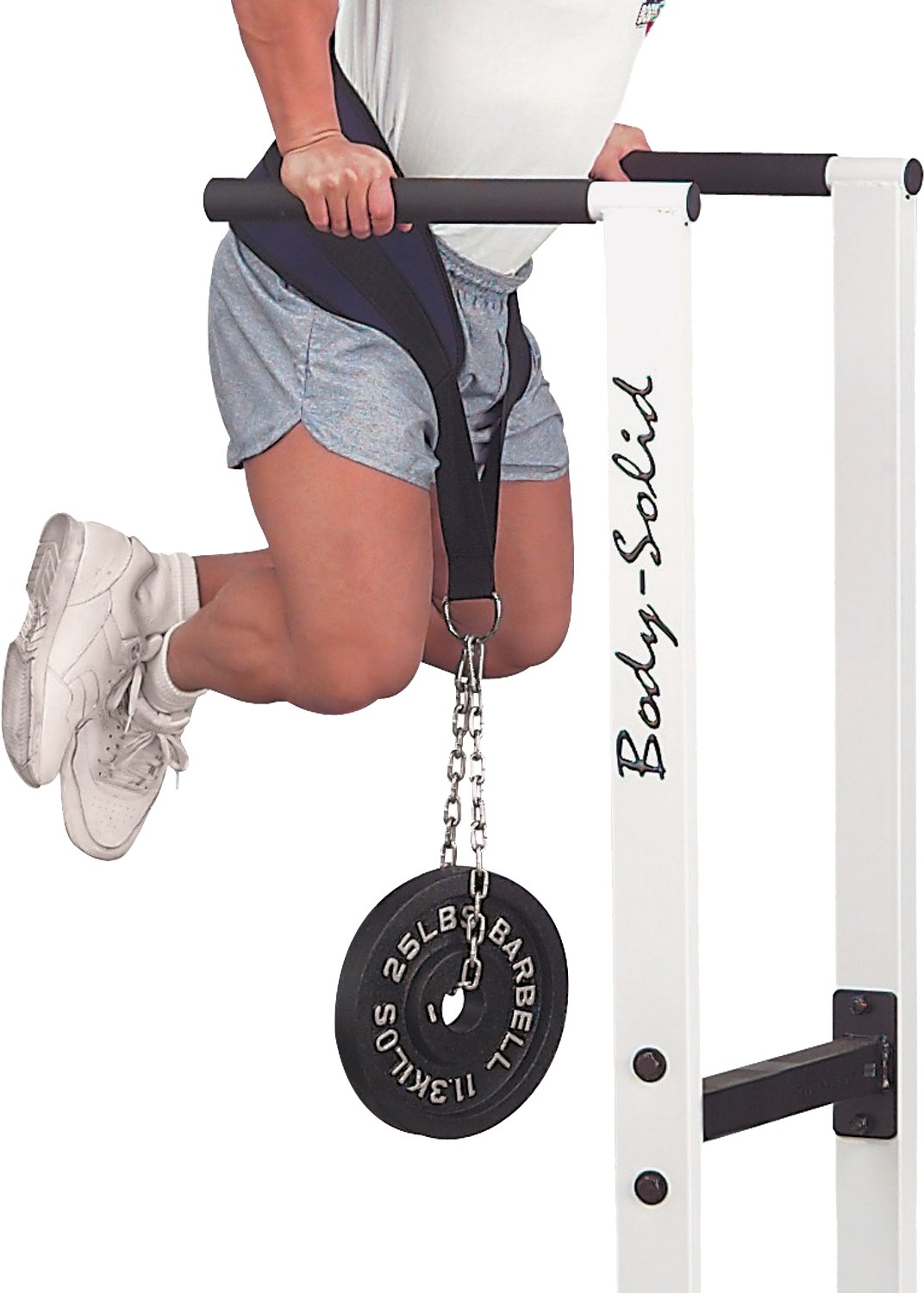
After you master the one arm dip, experiment with added resistance provided by a weight belt.


Body-Solid Nylon Dipping Belt


If you don't have access to a dip machine, then recruit somebody to hold your ankles and tell them to raise you while you're pushing up.